Basalt featured as Guest Architects in IQD Magazine
Basalt contributes the essay Irreplaceable Places

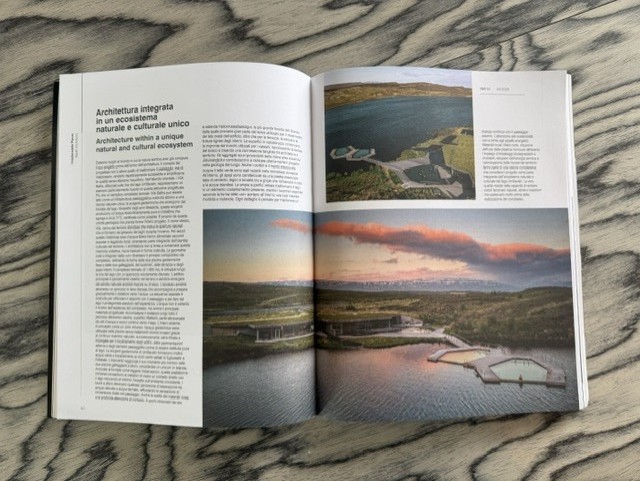
Basalt Architects has been invited to serve as Guest Architects for the latest issue of IQD Magazine, contributing the essay Irreplaceable Places alongside features of two of our projects Vök Baths and Earth Lagoon Mývatn.
Founded in 2005, IQD Magazine is an international architecture and design publication distributed in 39 countries. Since 2018, each issue has invited a Guest Architect to contribute essays, projects and editorial perspectives on themes shaping contemporary architecture.
Issue 83 explores the theme Irreplaceable Places—architecture that belongs to its context rather than simply fitting in anywhere. Through our essay and project features, we reflect on the importance of designing places that are shaped by landscape, culture and memory, and that contribute to a continuity extending beyond the buildings themselves.
Read the full essay here:
Irreplaceable Places
by Basalt Architects
Architects today operate in an increasingly connected world. Materials, technologies, design references, and labour move rapidly across countries and continents, allowing buildings to be designed and constructed in remarkably similar ways regardless of location. While this has brought significant efficiencies, it has also produced a pervasive architectural sameness that risks erasing local identity.
At the same time, this condition—a fundamental dilemma within the discipline—has renewed interest in the qualities that make places distinct, and in architecture that is deeply rooted in its context.
The character of a place emerges through the interaction of geology, climate, ecology, culture, and memory over long periods of time. It is shaped through countless relationships between people and their surroundings, accumulating gradually across generations. These conditions cannot simply be replicated elsewhere. They are what make places irreplaceable.
For architects, this raises an enduring challenge: how to create something new without diminishing what already exists, and how to intervene in a landscape or settlement while preserving the qualities that give it meaning.
Contemporary architecture has often treated the site as a neutral surface onto which new ideas are projected. An alternative, increasingly necessary approach begins not with intervention, but with attentive observation. In this view, the site is not a passive surface, but an active condition. Architecture becomes less an imposition of ideas and more an engagement with what is already present.
This way of working demands patience in a world where efficiency has become a dominant force. The qualities that define a place are not always immediately visible. They may be found in patterns of movement, in local rituals, in the way light interacts with a landscape, in the ways seasons transform it, or in stories passed from one generation to the next. Recognising these relationships requires attentiveness as much as design.
At a time when environmental concerns are forcing architecture to reconsider its impact on the world, working with the existing qualities of a place becomes unavoidable. Building is inevitably an act of change. The question is not whether we alter a place, but how: whether architecture disrupts existing conditions or works with them, strengthening relationships already in place.
Irreplaceable places remind us that identity is not something that can be manufactured. It is the result of time, adaptation, and collective memory. The role of architecture is therefore not to overwrite these layers, but to work within them—revealing what is already present while carefully adding to an ongoing continuity. In doing so, architecture can create the conditions for deeper engagement with place, allowing people not only to inhabit it, but to recognise their position within a continuity that precedes and will outlast them.